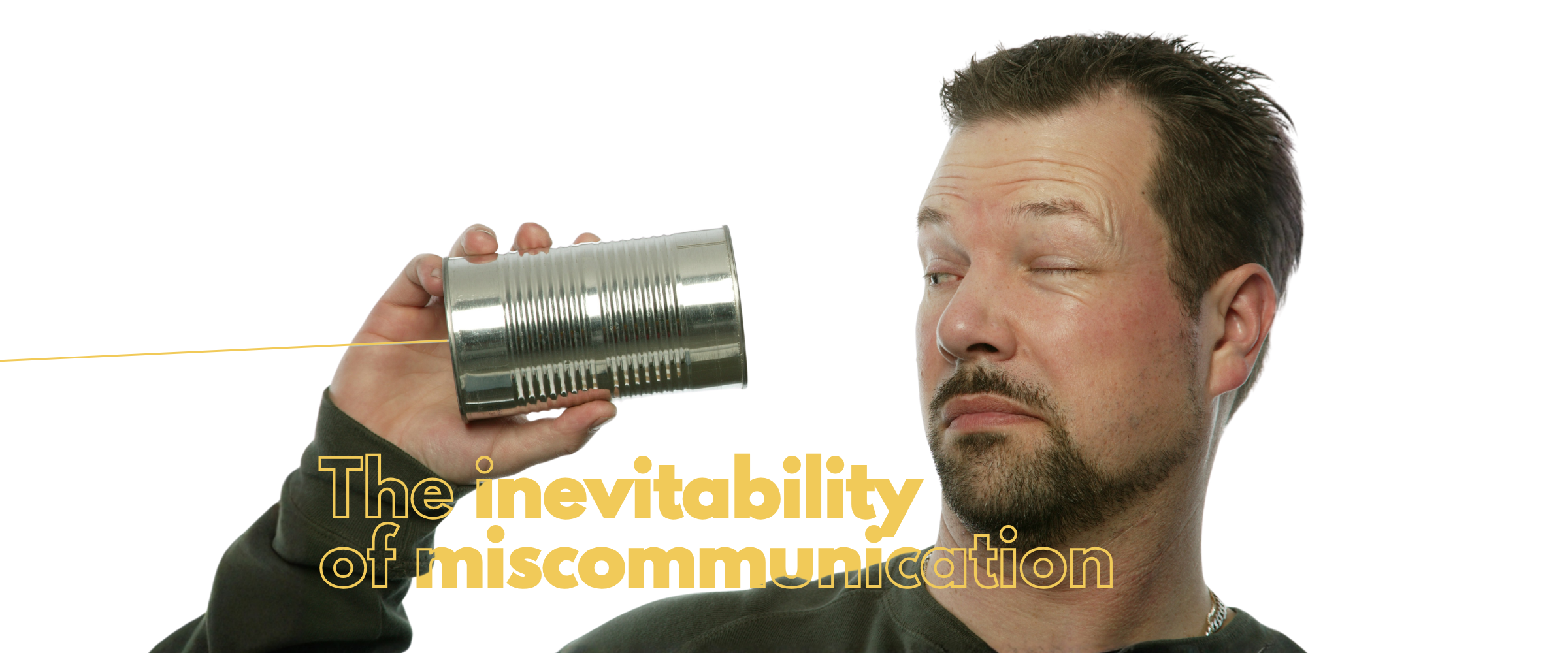
The Inevitability of Miscommunication & the Need for Unmiscommunication.
Let’s start with a thought experiment. You’re in a meeting. Your colleague says, “We need to move faster on this project.”
What you heard: We’re behind schedule and need to cut corners to catch up.
What she meant: We should prioritize ruthlessly instead of trying to do everything, because focus moves us forward faster than trying everything at once.
What your manager heard: We should add more resources.
All of you left the meeting thinking you’d agreed. You hadn’t.
This happens constantly, not because of incompetence or carelessness. It happens because language is so beautifully complicated, it’s a marvel we can understand each other at all.
Communication is Remarkably Fragile
So many variables go into our efforts to communicate that it’s a statistical probability that we will miscommunicate. Here’s what has to go right for communication to succeed:
Speaker side:
- We have a thought. It exists in our brain as a lived experience, a bundle of context, emotion, and half-formed intuition.
- We translate that into language. Already, we’ve compressed something that is richly layered into a narrow stream of words. Some of the meaning is already lost.
- We decide which words to actually say. According to Grice’s Maxims, we’re going to say as little as necessary to communicate. We don’t say certain things based on what we think the listener knows, their emotional state, the setting, power dynamics, and our assumptions about what matters to them. Please notice all the space there is here to be wrong.
- We deliver the words with tone, pace, pauses, and facial expression that feel right to us given our internal experience of what we’re saying. (This is particularly dangerous, though even more so in written communication, where we lack non-verbal cues)

Listener side:
- They hear the communication, but they won’t take it at face value. They will unconsciously interpret what was said, what wasn’t said, and how it was and wasn’t said through their own neurobiology, their recent experiences, their preexisting relationship to the topic, what they’re worried about, what they need to hear, and what they’re afraid to hear….
- They craft meaning. The brain doesn’t passively receive information, but actively predicts what you’re about to say, slots your words into existing patterns, and fills in gaps with assumptions.
- They interpret tone and body language through their emotional lens, which may be completely different from how you intended it.
- They may ask a clarifying question, but it may not be a quality clarifying question. For example, they could say “what?”, as if you’re to understand which of the many possible breakdowns of communication has occurred. Or they could ask about something completely irrelevant to the true source of miscommunication, because they aren’t even certain themselves of where the breakdown is occurring. Regardless, we now have to repeat the whole process again, and we might still miscommunicate.
Every single stage is a compression, a translation, a filtering, and an assumption-filling exercise. And every stage has a huge opportunity for error.
The Odds are Not in Your Favor
Consider the variables in a single three-minute conversation between two people:
- Vocabulary alignment: You each might use the same word but carry slightly different connotations from it. “Feedback” to one person means “let’s improve together.” To another it means “you’re doing it wrong.”
- Context: You know what you’ve been stressed about lately. They don’t. You reference something you both supposedly discussed last month, but they’ve had 47 conversations since then and genuinely don’t remember it the way you do.
- Assumptions about listener knowledge: You think something is obvious. It’s not obvious to them. Or worse, it is obvious, but for a different reason than you think, so you’re both “right” about different things.
- Temporal gaps: They’re thinking about something that happened 10 minutes ago. You’re thinking about something that happened 10 days ago. Your sense of urgency about the problem is completely different.
- Implicit rules: Some companies treat “Can you do X?” as a request. Others treat it as a polite instruction. Some teams view silence as agreement; others view it as dissent. You’re operating on one set of invisible rules, they’re operating on another.
- Emotional state: They’re defensive because of something that has nothing to do with you. Or you are. Defensiveness doesn’t just make people resistant to your message; it changes how their brain processes language. They start predicting meaning instead of receiving it.
- Interpretation of tone: Your hurried text reads cold to them. Your direct feedback reads mean to them. Your silence reads like abandonment to them. Same signals, different interpretations.
And that’s just communication between two people. Add a few more to the group, and the complexity multiplies. In a five-person meeting, each person is:
- Listening to the words
- Interpreting the tone
- Noticing who’s not talking
- Watching reactions of others
- Feeling their own status relative to the group
- Wondering what others think of what they just said
- Filtering their next thought through all of the above
The sheer computational load is staggering.
And the human brain does all of this while also trying to pay attention to the content.

Neurologically, We’re Set Up to Misunderstand
Our brains are prediction machines. We don’t wait to receive all the information before deciding what something means. The moment you hear the first word, your brain starts predicting what else is coming. It fills in gaps, categorizes, and connects to patterns from your past.
This is a feature, not a bug. It helps us think faster, but it also means we’re constantly guessing at meaning, and we are very good at fooling ourselves into thinking we understood something when we actually did not. At all.
A classic study: show someone a sentence with a typo and they won’t see the typo. Their brain predicts what the word “should” be and they read it as correct. Same thing happens with meaning. Someone says something slightly ambiguous, your brain predicts they meant X, and you read them as having said X, even if they said Y.
This isn’t a character flaw. No one is a bad person here.
This is how neural processing works when you have limited time and attention.
(like we all do living in this digital age of manufactured urgency!)
Couple that with the fact that stress makes this worse. When you’re stressed or defensive, your brain switches into prediction mode even more. You stop listening and start pattern-matching. “Oh, this is going to be criticism” and suddenly you’re not hearing what they’re actually saying, you’re hearing the last time someone criticized you in a similar situation.
Unmiscommunication is how we respond to Miscommunication
If you think about communication as a system:
thought → language → speaking → hearing → interpretation
where literally every step introduces error, the miracle is when communication does work.
It’s like flipping a coin 12 times and expecting heads every time. Every single time.
The statistical likelihood of perfect communication in any single exchange is… low.
Now a lot of teams work hard toward clarity. Saying it clearly the first time to avoid miscommunication. It’s a worthy goal, but I find it’s more helpful to have stop-gaps that assume miscommunication happened and not let things get too far before you Unmiscommunicate.

Here are my favorite stop-gaps:
- Redundancy. Say important things multiple ways and multiple times.
- Shared language. Have clarity around what words mean in your workplace.
- Have Meta-conversations, if something seems weird (like they should really be smart enough to not ask that dumb question) suspect miscommunication and ask about what’s happening.
- Don’t get offended by clarifying questions. We want people to ask as many clarifying questions as needed. (Just make sure you’re clarifying the right thing!)
- Don’t equate silence with understanding, and don’t ask “Do you understand?” No one wants to say no, and it’s too easy to say yes. Ask them to explain what they understand to you.
In this way, we can normalize miscommunication as part of the process rather than treating it as a failure.
Now when miscommunication does surface, we can Unmiscommunicate.
No blame, no stress, just “I see we were on different pages. Let’s get on the same page now and move forward.”
When we recognize that miscommunication isn’t a moral failure, that it’s a normal part of communication, we don’t need to become upset by it, but reset and get on the same page now.
The Edge: Where’s the Line?
If miscommunication is inevitable and normal, the question becomes: when is it a problem?
There’s a spectrum. On one end is the “We need to move faster” moment: a brief misunderstanding that gets caught and corrected. On the other end is a relationship where two people have been operating on completely different versions of reality for six months and it’s starting to affect decisions.
The difference isn’t that miscommunication happened. It’s:
How quickly it’s caught: In the first case, someone asked a clarifying question 5 minutes later. In the second case, no one realized the misalignment until the consequences showed up.
How much it compounds: A small misalignment corrected early is a 2-minute conversation. The same misalignment that goes unaddressed for months creates a 20-hour discussion where you’re trying to trace back where you diverged. And by then, decisions have been made on false premises.
How much it cascades: Some miscommunications stay localized. You thought the meeting was Tuesday and showed up Wednesday. Annoying, but contained. Other miscommunications become the foundation for other miscommunications. You misunderstood the goal, so you solved the wrong problem, so someone else had to re-solve based on your solution, and now three misalignments are stacked on top of each other.
How much it’s rooted in unexamined assumptions vs. simple information gaps: “I didn’t know you’d already solved this” is fixable in two seconds. “I assumed you were the kind of person who would handle the problem this way, and you assumed you should handle it differently, and neither of us ever questioned those assumptions” is a sign of something deeper.
So the real diagnostic question isn’t: “Did miscommunication happen?” Of course it did. The question is:
“Is this miscommunication being caught and corrected quickly enough to prevent cascading failures? Or is it being left to compound?”
A team with 100 small miscommunications that are caught and corrected immediately is functionally healthier than a team with 5 major miscommunications that no one notices until they’re expensive.

But Also, The Line Might Not Exist
Here’s the thing: there may not be a bright line between “normal miscommunication” and “a real communication problem.”
There might just be a sliding scale of how many miscommunications are happening, how quickly they’re being caught, and how much they’re being allowed to compound.
A “real communication problem” might not be a special category of miscommunication. It might just be what normal miscommunication looks like when the catching-and-correcting mechanisms break down.
It breaks down when psychological safety does:
- People stop asking clarifying questions because they’re afraid of looking stupid, or because the power dynamic makes it unsafe, or because they’re exhausted.
- Assumptions go so deep that no one even recognizes they’re assumptions anymore. Everyone just “knows” how things work around here, and when someone challenges it, it feels like a betrayal instead of a clarification.
- The feedback loop is too slow. By the time you realize you misunderstood, 10 other decisions have been made on top of the misunderstanding.
- There’s too much ego or political capital tied to being right, so admitting “I think we were operating on different assumptions” feels dangerous.
In these conditions, the same miscommunication that would be a 2-minute fix elsewhere becomes a 6-month silent rift.

So Here’s What This Means
If miscommunication is inevitable, then the question isn’t “How do we prevent it?” It’s “How do we set up systems where miscommunication is caught and corrected before it compounds?”
The answer is almost boring in its simplicity:
- Treat clarifying questions as a normal part of work, not a sign that something is broken.
- Make it safe to admit confusion. Not as a psychological nice-to-have, but as a structural feature. “I want to make sure I understand” should be as normal as “Can you pass the salt?”
- Build redundancy into important communication. Say things multiple ways. Write them down. Confirm them.
- Slow down on big decisions long enough to surface the assumptions you’re operating on.
- Make it explicitly okay to be wrong about what someone meant.
And maybe most importantly: stop expecting yourself and others to get it right the first time. You often won’t. The fact that you’re miscommunicating isn’t evidence of failure. It’s evidence that you’re human.
Miscommunication is the inevitable blooper of a marvelously complex system of humans translating experience into language, transmitting it through the noise, and reconstructing meaning on the other side.
The only real dysfunction is believing it shouldn’t happen.